Benazir Bhutto and Nawaz Sharif’s Last Meeting: A Historic Conversation About the Future of Democracy
 Ishak Soomro
Benazir Bhutto and Nawaz Sharif’s Last Meeting: A Historic Conversation About the Future of Democracy
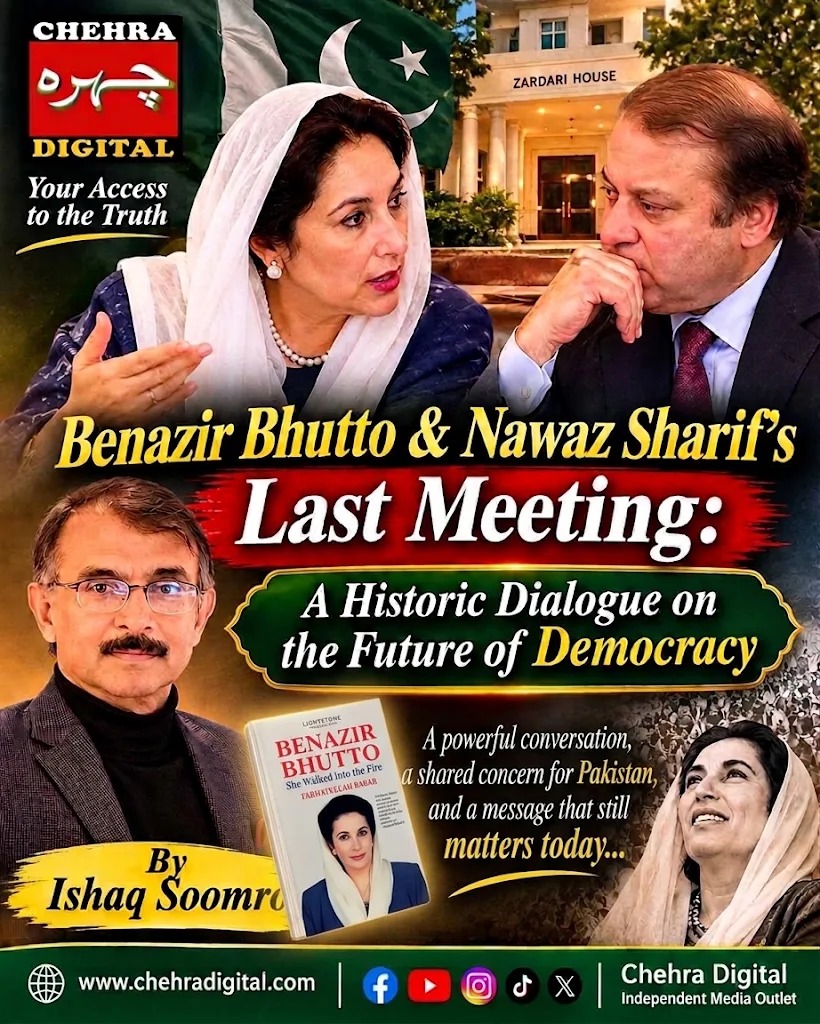
Some meetings in Pakistan’s political history may initially appear to be routine political engagements, but with the passage of time, their significance becomes extraordinary. The meeting between former Prime Minister Benazir Bhutto and Mian Nawaz Sharif at Zardari House in Islamabad in December 2007, 19 years ago, was one such historic encounter. It turned out to be the last face-to-face conversation between the two leaders.
During this meeting, both leaders not only set aside the bitterness of their political past but also spoke candidly about the continuity of democracy in the country, repeated interference in the political process, and the role of undemocratic forces in Pakistan’s political affairs.
An important eyewitness account of this meeting has been documented by Farhatullah Babar, former spokesperson and speechwriter to Benazir Bhutto, in his book Benazir Bhutto: She Walked into the Fire. Babar was personally present at the meeting and recorded the conversation between the two leaders, along with their emotions, expressions and gestures, in his memoirs.
Against this backdrop, Benazir Bhutto invited her former political rival and Pakistan Muslim League-Nawaz (PML-N) leader, Mian Nawaz Sharif, to dinner at Zardari House in Islamabad.
The meeting was particularly significant because, just a year earlier, the two leaders had signed the Charter of Democracy, an agreement aimed at ending the political confrontation of the 1990s and strengthening democratic institutions and the political system in Pakistan.
Those attending the dinner included Pakistan Peoples Party (PPP) Vice Chairman Makhdoom Amin Fahim and Yousuf Raza Gilani, while Nawaz Sharif was accompanied by Raja Zafarul Haq and one of his close associates. Farhatullah Babar was also present.
According to Babar, Benazir Bhutto opened the conversation by thanking Nawaz Sharif for accepting her invitation. She explained that she had invited him because the two leaders needed to seriously discuss recurring political interference, repeated derailment of the democratic process and the violation of the Constitution every few years.
Benazir made it clear that this cycle could not continue any longer and that Pakistan could not afford it if the country was to survive. She said she had spent considerable time reflecting on the issue during her years in exile, and the time had come for both leaders to work together to find a solution.
Addressing Nawaz Sharif, Benazir pointed out that both of them had served as Prime Minister of Pakistan twice. They had witnessed political interference and the role played by undemocratic forces during their respective tenures. Therefore, she argued, it was now their responsibility to do something about it.
Farhatullah Babar writes that Nawaz Sharif became visibly emotional after listening to Benazir. He immediately agreed with her position, saying that he too had given the matter considerable thought. Enough was enough, he said, and this cycle had to come to an end.
During the conversation, Nawaz Sharif went a step further and revealed that he had already decided what he would do if the democratic system were overthrown once again.
Surprised by his statement, Benazir asked whether he had really made up his mind and wanted to know what course of action he had decided to pursue.
Explaining his position, Nawaz Sharif said that if undemocratic forces interfered again, he would go to them and tell them that this was their Constitution, their country and their people. They could do whatever they wanted, but he would no longer be part of the process.
He then picked up a plate from the table, held it in both hands and extended it towards Benazir Bhutto, saying that he would leave the country and never return.
According to Nawaz Sharif, he could no longer be part of this political game. Those who seized power should be left to face the consequences of their own actions.
His extraordinary response left Benazir Bhutto equally surprised. She asked him where he would go and what he would do if he decided to abandon politics and leave the country.
According to Farhatullah Babar, Nawaz Sharif appeared deeply disillusioned by his experiences of political interference, exile and repeated removal from power. His tone and facial expressions reflected a mixture of helplessness, frustration and anger.
At that moment, Babar realised that the conversation was of extraordinary historical significance. Quietly, he took out a notebook and pen from his pocket and began jotting down the important points of the discussion.
However, Nawaz Sharif immediately noticed and stopped him, saying, "Mr Babar, don't write this down."
Benazir Bhutto also looked towards Babar and asked whether she had asked him to take notes. Babar apologised and immediately closed his notebook.
Farhatullah Babar writes that even after putting his notebook away, the conversation remained etched in his memory. He decided that from then on, he would observe not only the words spoken but also the facial expressions, gestures and tone of both leaders, because sometimes unspoken gestures convey more than words.
Responding to Nawaz Sharif's position, Benazir reminded him that he was the head of a political party and had served as Prime Minister twice. She herself was also the leader of a political party and had held the office of Prime Minister twice.
Neither of them, she argued, had the right to abandon the country and its people to the mercy of undemocratic forces by withdrawing from the political struggle.
Benazir acknowledged that she, too, sometimes became disheartened and even considered leaving politics. However, she maintained that running away from politics was not the solution. Instead, the two leaders needed to sit together and find a common way forward.
Her central argument was that those seeking to seize power must be sent a clear message: there could be no compromise on the supremacy of the Constitution or the people's right to govern themselves.
Pakistan, she emphasised, did not belong to any one individual or institution. It belonged to all its citizens.
Nawaz Sharif listened attentively to Benazir's arguments, but also expressed reservations about whether the undemocratic forces operating within the centres of power would be willing to accept any reasonable advice.
In his view, these forces wanted to run the country according to their own wishes to protect their interests and were unwilling to reform themselves.
Benazir did not dismiss his concerns. However, she maintained that political leadership had a responsibility to play its role despite these challenges.
After the meeting, while speaking to Farhatullah Babar, Benazir remarked, "Can you believe that Mian Sahib is so angry? But how can we run away and abandon the struggle?"
In response, Farhatullah Babar recalled a position once articulated by the late Khan Abdul Wali Khan: the forces seeking power could only be restrained if the people of Punjab themselves made that decision.
Babar further observed that Nawaz Sharif was the first major political leader from Punjab to speak so emphatically about democracy and political interference in this manner. Perhaps, he suggested, Punjab was finally beginning to awaken.
Benazir Bhutto responded briefly: "Let's see."
But history had something else in store.
On December 27, 2007, Benazir Bhutto was assassinated in a terrorist attack at Liaquat Bagh in Rawalpindi.
Her final face-to-face meeting with Nawaz Sharif, therefore, remains a poignant moment in Pakistan's political history — a conversation shaped by the shared experience of political struggle, the hope for democratic continuity and the determination to end the cycle of undemocratic interference in the country's affairs.