INCLUSIVE DEVELOPMENT OF CITIES THROUGH HIGH QUALITY BELT AND ROAD COOPERATION
 Irfan Ali
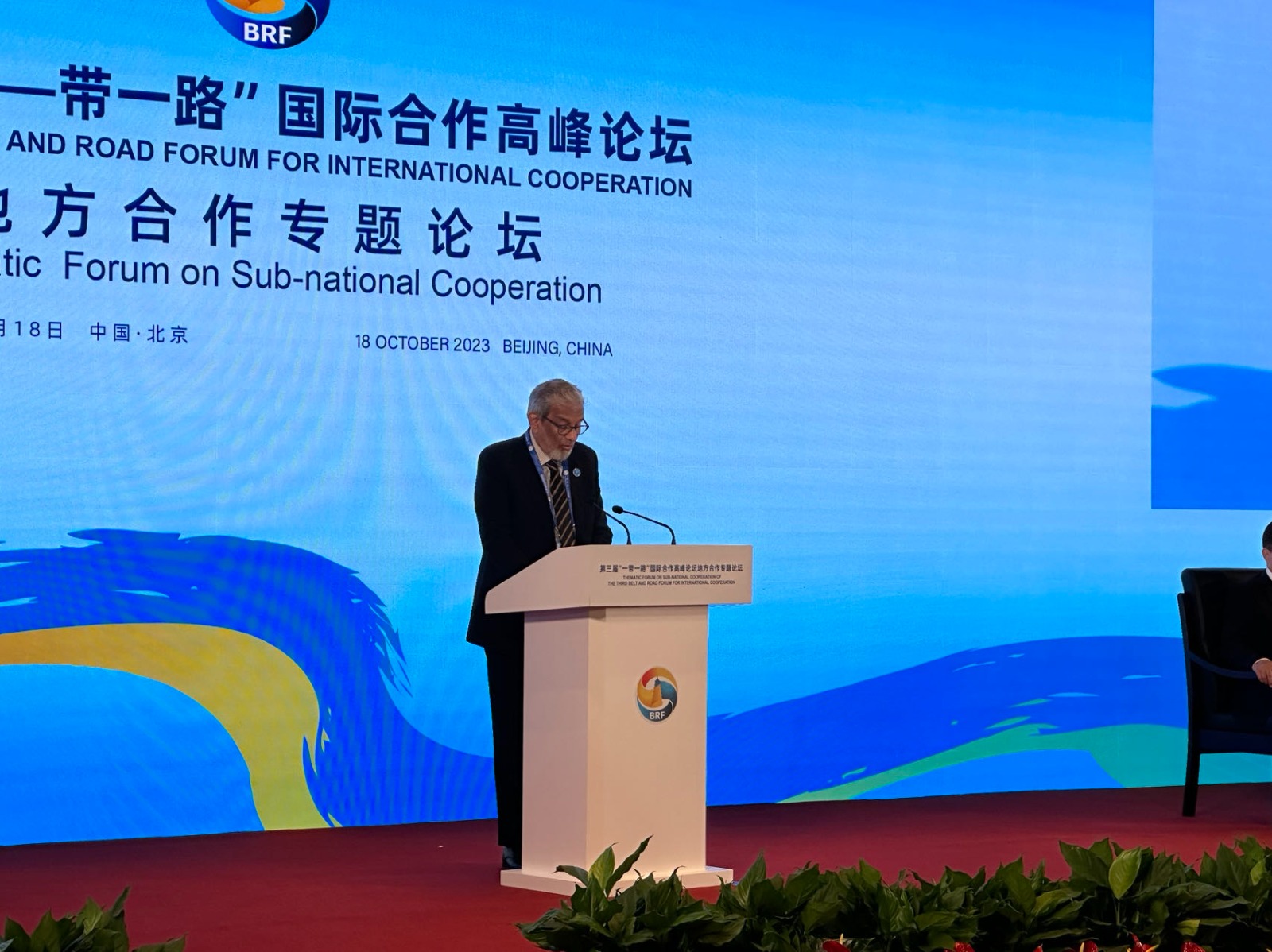
BEIJING Caretaker Sindh Chief Minister Justice Maqbool Baqar presenting the CPEC-unitive $2bn Karachi Circular Railway in the 3rth Belt and Road Forum said it was not simply about constructing tracks and stations; it was about fostering connectivity and economic vitality to open doors to greater trade, bolstering commerce and industry, and creating job opportunities, thus economic benefits would extend beyond Karachi, reaching the heartlands of Pakistan.
This he said while speaking at the 3rd Belt and Road Forum for International Cooperation organised at National Convention Center, Beijing.
At the outset, the caretaker Sindh CM thanked the President of China Mr. Xi Jinping for convening an important gathering and providing them with a remarkable platform.
Justice Baqar said that `The Belt and Road Cooperation’ was a vast and thoughtful endeavor that has altered the way nations communicate trade and collaborate with each other, reflecting China's leadership and commitment to inclusive development of cities in collaboration with the states of Asia, Europe, and African continents.
The interim CM said that the Belt and Road Cooperation has sought to promote infrastructure development, unimpeded trade, people-to-people bonds, economic growth, regional integration, cultural interchange, and environmental sustainability around the world for better living standards for privileged and underprivileged people, especially in cities of the developing world.
As we are aware, urbanization is increasing progressively around the globe due to the high tendency of people moving to cities to acquire a better standard of living for themselves and their future generations, Justice Baqar said and added urbanization has the potential to change economics and social condition of a country as it helps in achieving higher economic growth by including the most deprived strata of the population in a country, however, it can also lead to urban poverty and depleted infrastructure if not managed properly and not adequately resourced. To ensure sustainable urbanization, policymakers need to focus on inclusive urban development which is a key determinant of sustainable urban development.
The Sindh CM said that urban expansion without inclusive policies could put societies at risk where new residential expansion areas could easily result in social exclusion and mobility poverty. “Guaranteeing sustainable and inclusive urban development implies, among other things, fair access to the public transport network - and to the main opportunities/activities being reached through it - for all individuals/groups in the whole society,” he said and added the transportation system was crucial for facilitating social participation and leveling inequalities.
The CM said that studies showed that cities were responsible for half of road vehicle emissions, which led to health problems and thousands of deaths each year. “They are also congested with traffic, which causes pollution, stunts economic growth, and affects people’s quality of life. How then, can we create sustainable transport systems that account for the future economic, environmental, and cultural interests and well-being of the general population,” the CM questioned.
It is only recently that policymakers across the developing world have begun to grasp the fundamental role of transport in shaping inclusive development of cities by ensuring access to jobs as well as to quality education and healthcare, and, in consequence, leading to socio-economic growth and more equal societies, Justice Baqar said and added that mobility was not just about getting from point A to point B but instead, it was the way to move people to a higher place on the social ladder, therefore, the development of the right approach to equitable urban transport is absolutely critical to sustainable urbanization.
The Sindh CM said that Karachi, the economic hub of Pakistan and capital of Sindh province, was a city of over 20 million people, spanning about 3780 square km. “It is where major networks of trade, transport, and communication meet, yet, every single day, millions commute without any proper and safe public transport system,” he said and added the complex and heterogeneous traffic pool is largely dominated by private vehicles, most of which are poorly maintained and managed, thus creating traffic and environmental hazards in addition to lack of mobility options for the citizens.
Justice Baqar said that in recent years, the Sindh Government has made considerable strides in alleviating the mobility issues of the public in this mega city by embarking on an ambitious mass transit plan incorporating resources from its own budget, as well as support from the Federal Government and donors such as World Bank and Asian Development Bank. “By focusing on the pivotal nature of transport infrastructure as the key to inclusive development of this mega city, Sindh Government has initiated several ambitious public transport projects such as an integrated network of Bus Rapid Transit systems including dedicated bus lanes, modern stations, and eco-friendly buses.
Out of the seven BRTs planned for Karachi, two have been completed whereas another two are under construction, the CM said and added another major initiative was the introduction of public busses in mixed traffic mode in Karachi as well as other smaller cities of the province, with a special emphasis on provision of safe and reliable transport option for women.
The CM told the forum of a central and transformative transport initiative for Karachi that united our nations in a shared vision for progress—the Karachi Circular Railway (KCR) project under the China-Pakistan Economic Corridor (CPEC).
The KCR is the cornerstone of our vision for modernizing Karachi's transportation network, the CM said and added this extensive railway network represented an estimated investment of $2 billion, underscoring its scale and significance in enhancing urban mobility and driving economic growth.
The KCR, with its 43-kilometer stretch, is designed to connect key areas within the city as well as integrate with the city’s BRTs, thus providing a sustainable, reliable, and efficient mode of transportation. This circular railway will play a crucial role in facilitating the movement of people and goods, reducing traffic congestion, and enhancing productivity, ultimately improving the overall quality of life for the residents of Karachi.
The CM said: “KCR’s viability speaks for itself - the project is anticipated to serve a ridership of approximately 650,000 passengers per day which underscores the high demand for a reliable public transportation system and emphasizes the vital role this railway will play in addressing the city's mobility needs.”
Justice Baqar said that the KCR was not simply about constructing tracks and stations; it was about fostering connectivity and economic vitality. “It will open doors to greater trade, bolstering commerce and industry, and creating job opportunities. The economic benefits will extend beyond Karachi, reaching the heartlands of our nation,” he said.
Leveraging China's expertise and experience in infrastructure development, this collaborative effort is poised for success., the CM said and added that the partnership between our nations was a beacon of hope and progress, showcasing how collaboration and shared vision can drive mutual growth and prosperity.
He said his government was committed to ensuring the seamless execution of this project, adhering to the highest standards of safety, efficiency, and sustainability. “Our goal is to create a model urban railway system that embodies innovation and progress,” he said.