From Presence to Power: DigiMAP Concludes Women’s Leadership Pilot with National Charter and Regional Profiles
 Sidra Arif
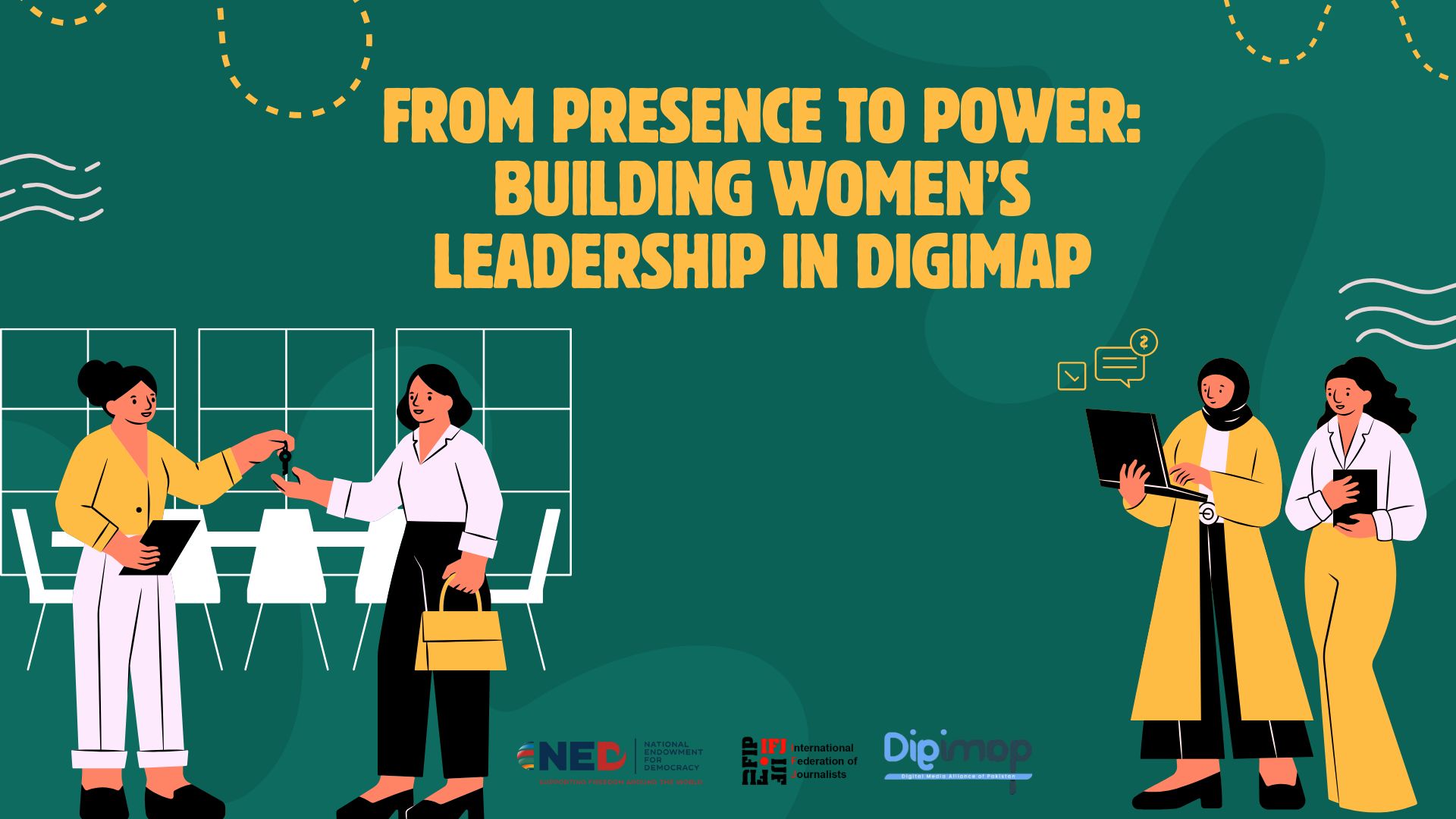
Islamabad, The Digital Media Alliance of Pakistan (DigiMAP), in collaboration with the International Federation of Journalists (IFJ) and the National Endowment for Democracy (NED), has successfully concluded the dissemination phase of its women’s leadership pilot, “From Presence to Power: Building Women’s Leadership in DigiMAP.”
The pilot program brought together ten women digital media professionals from Balochistan, Khyber Pakhtunkhwa, Sindh, Punjab/Islamabad Capital Territory, and Gilgit-Baltistan. Designed as a structured mentorship and leadership development initiative, the program aimed to translate women’s professional presence into institutional influence and decision-making authority across Pakistan’s digital media ecosystem.
Participants engaged in facilitated leadership sessions and one-on-one mentorship with senior women media leaders. Discussions and activities focused on newsroom hierarchies, access to decision-making, digital safety, economic sustainability, and editorial authority—providing a holistic framework for women’s leadership development.
A key outcome of the pilot was the co-creation of the Women’s Participation & Inclusion Charter, which outlines ten core leadership principles. Moving beyond symbolic representation, the Charter emphasizes structural reform by linking women’s leadership to decision-making authority, safe professional environments, economic stability, policy engagement, and long-term mentorship.
The pilot highlighted geographic diversity in Pakistan’s media landscape. From investigative reporting in Balochistan to editorial leadership in Khyber Pakhtunkhwa, storytelling and newsroom management in Sindh and Punjab/ICT, and audience engagement in Gilgit-Baltistan, the program showcased emerging leadership across regions.
DigiMAP released ten leadership profiles alongside the ten Charter messages during the dissemination phase, illustrating that regional women journalists are not just participants—they are capable decision-makers and future leaders.
Participants consistently identified safe professional networks, digital security training, structured mentorship, and economic empowerment as essential for sustainable leadership. The program also reinforced the importance of editorial authority that extends to budgeting, strategic planning, and institutional policymaking.
DigiMAP officials noted that the pilot provides a scalable model for building women’s leadership in digital media. By integrating mentorship, policy frameworks, and public visibility, the initiative sought to shift women’s roles from participation to influence.
With continued support from IFJ and NED, DigiMAP plans to expand future leadership tracks, digital safety initiatives, and collaborative policy engagement, further strengthening regionally diverse women leaders.
The Women’s Participation & Inclusion Charter and leadership profiles remain publicly accessible as resources for media organizations, civil society, and development actors committed to advancing gender equity in journalism.
The initiative underscores a central principle: sustainable newsroom reform requires structured pathways for women’s leadership that are grounded in safety, authority, and economic viability.