Workshop Continues for the Second Day Under the Title “Rasool Bux Palijo School of Thought”
 Chehra WebDesk
Hyderabad
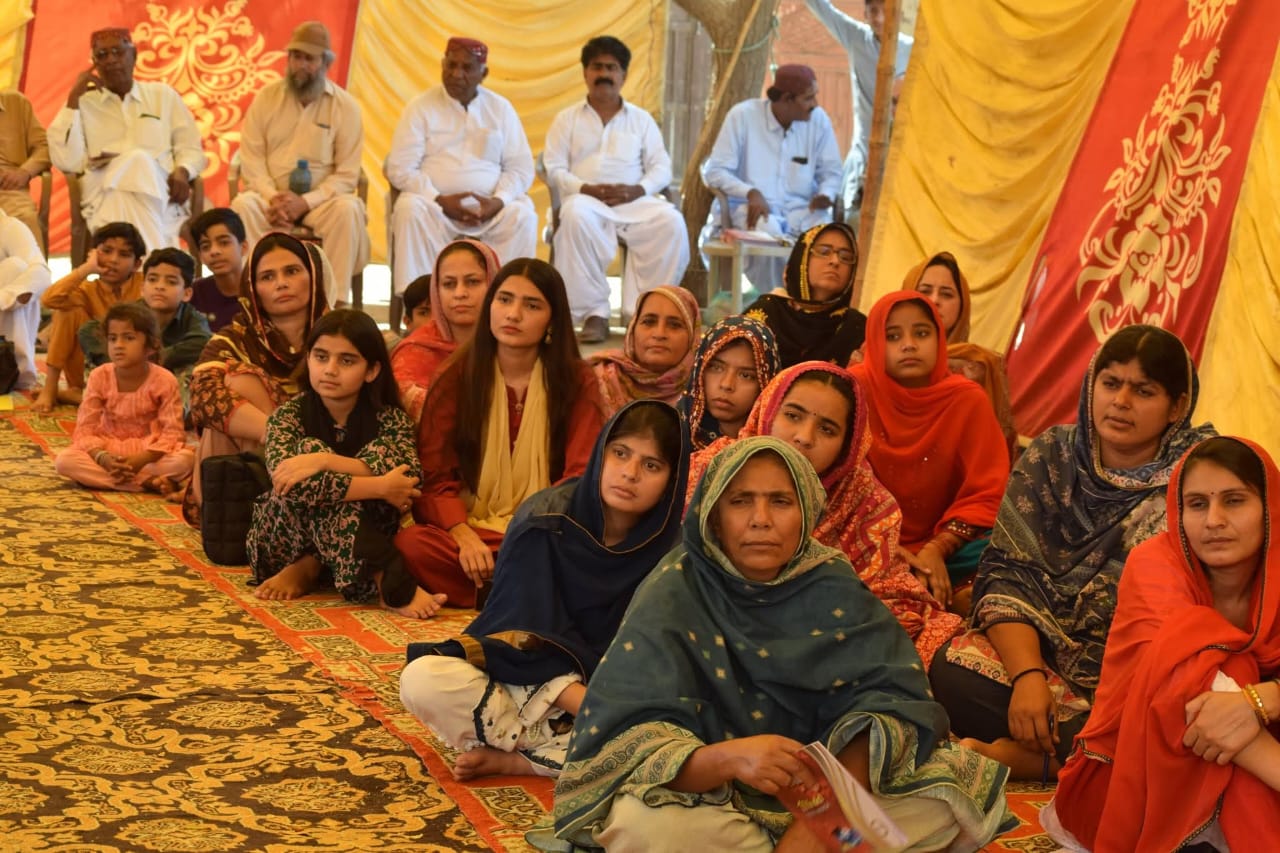
A three-day educational and training workshop organized by Awami Tehreek under the title “Rasool Bux Palijo School of Thought” continued for the second day in the village of Pubhan Sharif near Hyderabad. On the second day of the workshop, Senior Awami Tehreek leader Abdul Qadir Ranto, Pakistan Mazdoor Kisan Party leader Professor Syed Azeem, renowned writer Mir Hassan Arisar, Javed Rajpar, Dr. Qasim Sodhar, central Awami Tehreek leaders Advocate Ismail Khaskheli and Advocate Izhar Daudpoto, SST Leaders Atif Mallah, Ghulam Ali Zewar and others delivered lectures.
Participants included Awami Tehreek Central President Advocate Vasand Thari, Senior Vice President Noor Ahmed Katiar, Vice President Sattar Rind, Sindhyani Tehreek Central President Umrah Samoon, Sindhi Hari Tehreek Central President Ghulam Mustafa Chandio, Awami Tehreek Deputy General Secretary Advocate Raheel Bhutto, central leaders Dr. Dildar Laghari, Noor Nabi Palijo, Advocate Khalid Tunio, Sindhyani Tehreek leader Sabhani Dahri, Sindhi Shagird Tehreek Central Organizer Aitizaz Gaincho, Sujaag Bar Tehreek Central Organizer Sarmad Saindad Khaskheli and others.
Speaking on the history of Awami Tehreek, senior leader Abdul Qadir Ranto said that in the 1970s the founder of Awami Tehreek, Rasool Bux Palijo, analyzed the issues faced by the people of Sindh and Pakistan and concluded that the people were suffering from three major problems.
The first was the national question, because the state is based on national inequality, resulting in some nations exploiting others.
The second was the class question, where feudal lords and capitalists exploit peasants and workers.
The third was the democratic question, as Pakistan has experienced long periods of martial law.
He said that since its formation Awami Tehreek has been raising awareness among the people and mobilizing them to struggle against these issues.
Speaking on the impact of labour laws in Punjab and Sindh, Pakistan Mazdoor Kisan Party leader Professor Syed Azeem said the Labour Code has legalized the contract system and eliminated permanent employment. Workers have been deprived of their right to strike and strikes have been banned in public utilities. As a result of this legislation, the government has been strengthened while workers have been weakened. He added that the Labour Code was introduced under pressure from the European Union and that such legislation raises serious questions about national sovereignty.
Speaking on the importance of Palijo’s thought in the construction of modern Sindh, Mir Hassan Arisar said that the thought of Palijo is based on organization, training and movement. Palijo believed that democratic, class and national struggles are interconnected and cannot be separated. The role of revolutionary ideology is to guide revolutionary practice. A national, popular, democratic and class revolution was the objective of Rasool Bux Palijo.
Speaking on “Marxism and Our Specific Conditions,” Javed Rajpar said that Marxism is a universal historical theory applicable across the world but not necessarily in the same form everywhere. The key factor is the specific historical conditions under which it is applied. Without understanding the particular conditions of Pakistan and the subcontinent, it cannot be properly implemented. Among these conditions are the Asiatic mode of production, the caste system, the oppression of women, the self-sufficient rural system, Asiatic feudalism, reactionary capitalism, colonial-type state structures, militarized and religious states, and the role of global imperialist forces.
Speaking on the comparative analysis of Sindhyani Tehreek and other women’s organizations, Dr. Qasim Sodhar said Sindhyani Tehreek is different because it fights not only against gender oppression but also against class, national and other forms of oppression. In contrast, many other organizations mainly represent women from the upper and middle classes and focus primarily on gender issues only. Sindhyani Tehreek is a full-time revolutionary organization striving for the liberation of both women and men of Sindh.
Speaking on the role of Russia and China in the current global situation, Atif Mallah said American rulers want to dominate the entire world and therefore seek to block the rise of Russia and China. He said the American public is against war while American rulers are driven by war hysteria. The United States considers itself the master of the world. American imperialism is moving toward decline.
Speaking on the situation in Iran, he said the main objective of the United States is regime change. He said the United States attacked Iran and carried out bloodshed. Despite the martyrdom of Iran’s Supreme Leader Ayatollah Ali Khamenei, Iran’s administrative system did not stop even for a minute, which resulted in a major defeat for the United States. The concept of collective leadership rather than rule by an individual helped Iran survive the war situation. He said Iran has not attacked any Arab or Muslim country, including Saudi Arabia, the United Arab Emirates, Qatar, Kuwait and Bahrain, but has targeted American bases present there. These attacks exposed Israel’s strong defense system, and Arab states that relied on the United States realized that America cannot guarantee their security. He added that Iran’s war against the United States and Israel is not a religious war but a national and anti-imperialist struggle, they are protecting there six thousands long civilization and therefore the people of Iran deserve full support.
Ghulam Ali Zaor, speaking on the topic of a revolutionary party, said revolutionary parties do not function on personalities but on principles and ideology. A revolutionary worker must possess class consciousness and be equipped with scientific revolutionary knowledge. Such a worker struggles without personal interest and stands against feudal and capitalist oppression.
During the workshop, Sindhyani Tehreek leaders Sindhu Mallah and Azmat Kaloi, Sindhi Shagird Tehreek organizer Aitizaz Gaincho, Sindhi Hari Tehreek Qambar-Shahdadkot vice president Faqeer Ali Gul Chandio, Muhammad Detho and others presented national and revolutionary songs.
Meanwhile, Awami Tehreek Central President Advocate Vasand Thari, Deputy General Secretary Advocate Raheel Bhutto, central leader Ali Muhammad Kalmati and Noor Nabi Palijo said in a joint press statement that the rulers have thrown a “petrol bomb” on the people. Increasing petrol prices amounts to economic massacre of the public.
They said the sudden increase of 55 rupees per liter in petrol and diesel prices is equivalent to dropping an inflation bomb on the people. The cost of American wars and imperialist interventions is being imposed on the people of Pakistan in the form of petrol price hikes, which is unacceptable. When Pakistan already has sufficient oil reserves, what justification is there for such a massive increase? They said the government is implementing anti-people policies under the dictates of global imperialist institutions, especially the IMF. Under IMF dependency, Pakistan’s economy is being suppressed while the public is being pushed toward inflation, unemployment, hunger and poverty.
The leaders demanded that the 55-rupee increase in petroleum prices be immediately withdrawn. Permanent subsidies should be provided on petroleum products to give relief to the public. Petroleum levy and other unnecessary taxes should be reduced so that people can access affordable energy. They also called for a clear strategy to free Pakistan from the economic pressure of global imperialist institutions and from dependence on the IMF.