The Martyrs of the MRD Movement of 1983
 Ishak Soomro
Four decades
ago, on August 14, 1983, the Movement for the Restoration of Democracy (MRD),
an alliance of almost all major political parties in the country, formally
launched its struggle to end General Zia-ul-Haq’s dictatorship and martial law.
In the first
phase, leading political figures and workers began offering themselves for
arrest at major intersections and public places in cities. The movement was
launched in major cities including Karachi, Lahore, Quetta and Peshawar, as
well as in other parts of the country. In Sindh, the movement began with
extraordinary momentum and massive public participation. Thousands of people
would gather whenever political leaders were arrested in Sindh. Every day,
workers would come out onto the streets chanting slogans, while crowds of
people welcomed them, put flower garlands around their necks, raised slogans
with them and accompanied them towards police stations. Police and other
law-enforcement personnel would arrest them on the way.
Within only a
few days, thousands of workers in Sindh had courted arrest. Prisons and police
stations across the province became overcrowded. It became difficult for the
police and administration even to keep the arrested workers in custody
overnight. In some places, workers who had offered themselves for arrest at
police stations were sent home at night and returned to the stations the
following morning to sit there again.
According to a
cautious estimate, between 20,000 and 25,000 people were arrested in Sindh
during the 1983 movement, including more than 100 women. Nearly 800 people lost
their lives. At that time, newspapers, operating under strict censorship, were
the only regular source of news. People in cities and villages would gather
every day to listen to BBC London broadcasts for information about what was
happening.
During the
jail-filling campaign, very large rallies were also held across Sindh. Clashes
with police, blocking of roads, baton charges, tear gas and acts of vandalism
became routine. The number of people offering themselves for arrest increased
to such an extent that, at times, police personnel disappeared from the
stations and avoided making arrests. During the movement, several police
officers refused to perform their duties and began removing their uniforms and
police armbands. This created a situation resembling civil disobedience,
particularly in Sindh.
Several cities
would shut down every day, while in many areas the situation resembled a
curfew. In addition to political workers, journalists, writers, poets and
intellectuals were also arrested. Some political workers, journalists and
writers were publicly sentenced to flogging by military courts.
In these
circumstances, Ghulam Mustafa Jatoi, who was then president of the Sindh
chapter of the Pakistan People’s Party and was leading the MRD movement, wrote
a letter from the Karachi Jail Rest House asking party workers to end the
movement. However, the people of Sindh rejected his appeal, and the movement
continued in the province for several more months.
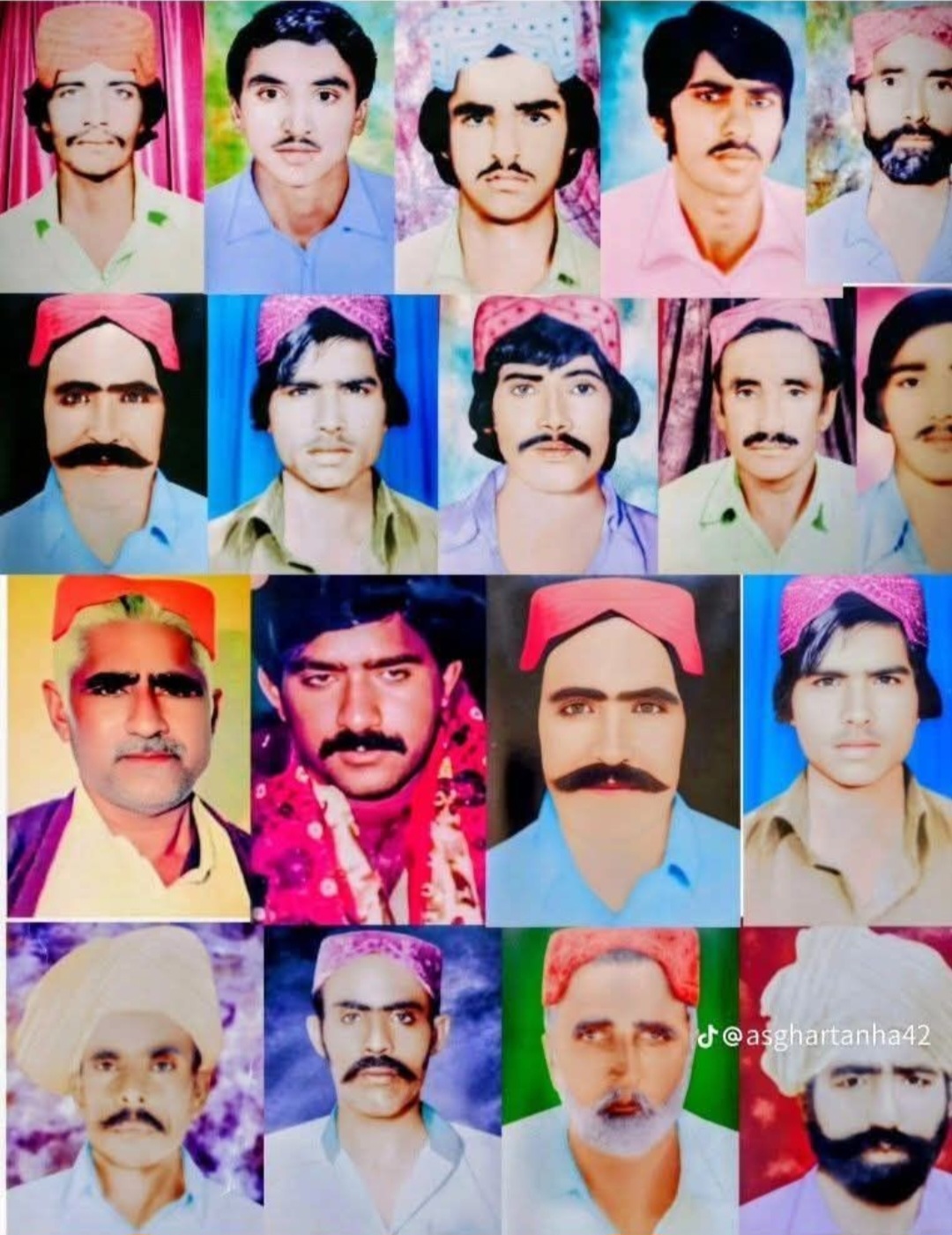
The biggest
incident of the MRD movement took place 43 years ago, on September 29, 1983,
near the town of Sakrand on the National Highway. Party workers and hundreds of
villagers were protesting when law-enforcement personnel passing through the
area opened fire on them. As a result, 16 people were killed and 51 others were
injured and arrested. Seventy-year-old protest leader Panhal Khan Chandio and
his son, Ghulam Abbas Chandio, were also arrested. They were tried by a
military court in Khairpur and sentenced to rigorous imprisonment. Severely
injured workers were being treated at the Civil Hospital in Nawabshah when they
were taken away from the hospital and imprisoned.
Among the 16
people who were killed that day, nine were farmers. Two were students of
Sakrand High School. One was a Manghanhar fakir who used to play the drum
during celebrations and bring joy to people. Another worked as a daily wage laborer
in Sakrand city; one ran a shop; another sold milk; and one was a goat herder.
They were all ordinary workers belonging to the lower-income sections of
society.
When I and a
few journalist friends from Sakrand reached the scene in the evening, the blood
of the dead and wounded had not yet dried on the National Highway. Their shoes,
slippers and other belongings were scattered across the road. Eyewitnesses told
us that the protesters were unarmed and were reciting the Holy Quran when
indiscriminate firing was opened on them.
The brutal
operation continued for nearly four hours. According to eyewitnesses, police
trucks were driven over several wounded protesters, killing them. The following
morning, we went with hundreds of people from Sakrand to the village of Panhal
Khan Chandio, where the families of those killed were burying their loved ones.
Besides the bereaved families, the now Member of the Sindh Assembly, Ghulam
Qadir Chandio, was also present and receiving condolences from the people who
had come to the village.
Ghulam Qadir
Chandio is known as a representative of the working class who has continued to
be elected for nearly 30 years. In 1995, Benazir Bhutto nominated him as a
member of the Senate of Pakistan for a six-year term. He was subsequently
elected to the Sindh Assembly for the fifth time. He has consistently played
the role of a party worker and an ordinary political activist, both at public
gatherings and on the floor of the provincial assembly.
The news of the
September 29, 1983 incident was broadcast by the BBC as its leading news story.
Radio Pakistan also reported the incident, stating that 16 people had been
killed and 51 injured and arrested in firing between law-enforcement personnel
and what it described as “miscreants” near Sakrand on the National Highway.
More than 43
years have now passed since the movement. The MRD struggle continued for a long
period and was more active in Sindh than in other parts of the country. It is
also important to recall that Sindh’s nationalist forces opposed the movement.
Nationalist leader G.M. Syed described the MRD struggle as a “movement of grave
robbers.”
Today, when
there is renewed discussion about the creation of new provinces and
administrative units in the country, opposition has emerged not only from
nationalist parties but also from the Pakistan People’s Party, which has
historically remained a major political force in Sindh and currently holds more
than two-thirds of the seats in the Sindh Assembly. Along with its stated
opposition to new provinces and a resolution adopted by the assembly, for the
first time a day was observed on September 12 to pay tribute to the martyrs of
MRD in Khairpur Nathan Shah.
Through this
initiative, a message was conveyed to the powerful circles that any attempt to
create new provinces could once again provoke a strong popular response from
Sindh, similar to the MRD movement.
Because of the
historic struggle waged by the people of Sindh, they came to be recognized
around the world as a democratic and anti-dictatorship people. The MRD movement
remains, even today, an example of struggle and courage for those who believe
in democracy across the region.