Barriers and Traditions, Yet the Journey in Journalism Continues: An Inspiring Story of Two Women
 Sidra Arif
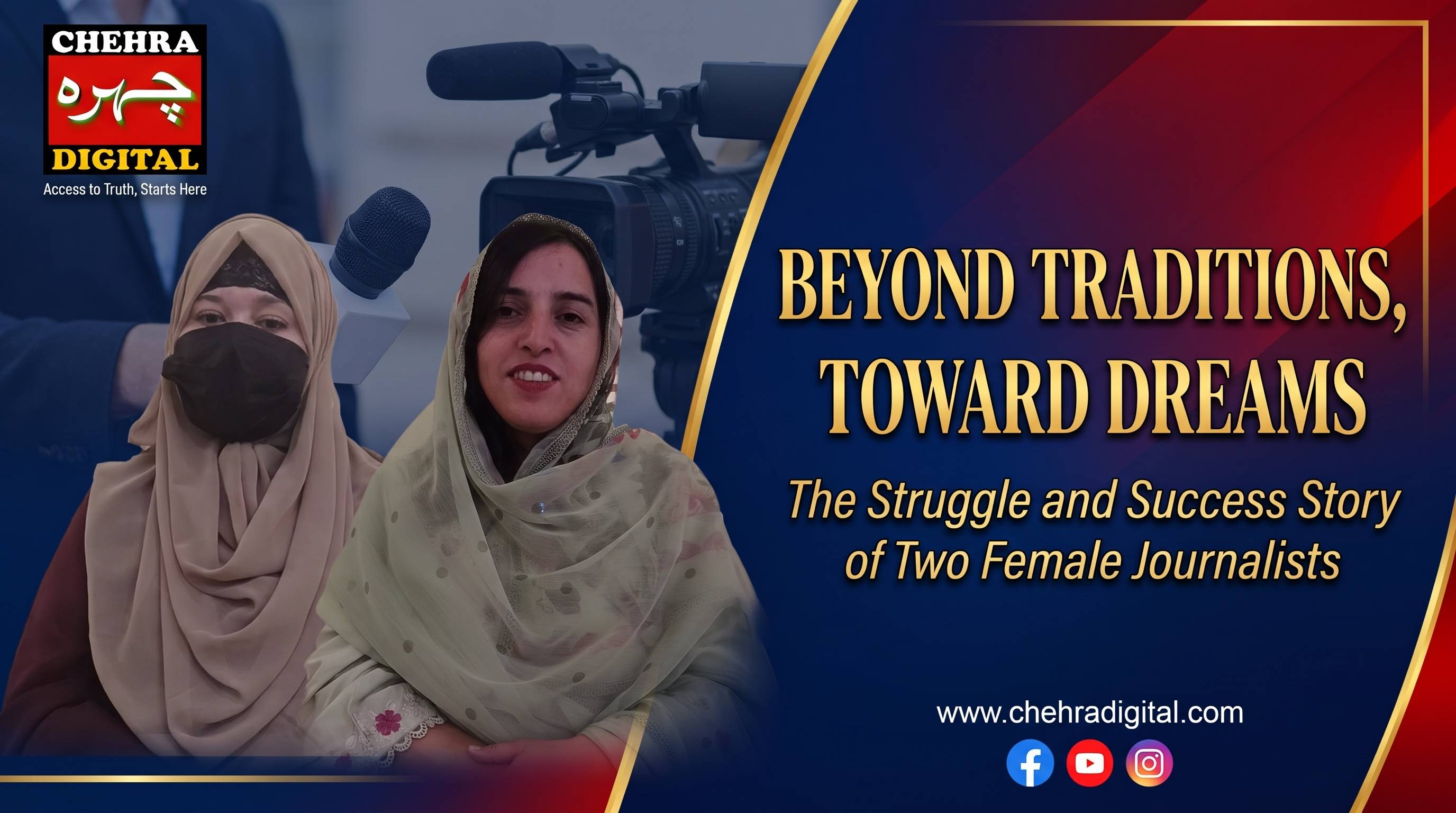
From the Voices of Gilgit-Baltistan to the Global Media Stage: Shireen Karim Is Creating Her Own Path
In a region where women face barriers to healthcare, education, protection and economic opportunities, Shireen Karim has turned journalism into a platform for change. Despite limited resources and professional challenges, she established her own media outlet, represented Gilgit-Baltistan internationally and demonstrated that when opportunities are scarce, women can create their own.

Known for its breathtaking mountains, picturesque valleys and natural beauty, Gilgit-Baltistan is often portrayed as one of Pakistan's most beautiful regions. Yet beyond its spectacular landscapes lie social challenges that rarely receive sustained attention in mainstream media.
For many women in the region, access to healthcare, education, safe transportation, protection from violence and economic opportunities remains a serious concern.
Among those working to bring these issues into public conversation is Shireen Karim, a journalist from Gilgit-Baltistan who has made women's rights and representation a central part of her professional journey.
She is the founder and owner of Women TV, a media platform through which she seeks to highlight women's experiences and bring overlooked stories to a wider audience.
For Shireen, journalism is not simply a profession. It is a way to connect marginalised communities with institutions and decision-makers.
Beyond the beauty of Gilgit-Baltistan
Gilgit-Baltistan's natural beauty often dominates its public image, but Shireen believes the region's social and economic realities deserve equal attention.
She points to the region's dependence on federal financial assistance and limited revenue-generation opportunities as major challenges affecting public services and development.
However, she is particularly concerned about the difficulties faced by women.
Domestic violence, inadequate healthcare, limited educational opportunities and a lack of safe transportation are among the issues she believes require urgent attention.
One of her most serious concerns is the absence of a Dar-ul-Aman, or women's shelter home, in Gilgit-Baltistan.
According to Shireen, women who need protection from domestic or other forms of violence may be kept in police stations instead of being provided with safe accommodation.
She considers this a deeply concerning human rights issue. Women seeking protection should have access to secure shelters where their dignity, privacy and safety are respected.

Journalism as a voice for women
Shireen has focused much of her reporting on issues that directly affect women's everyday lives.
Her work highlights domestic violence, transportation difficulties, healthcare shortages, educational inequalities and women's access to basic rights.
She draws attention to the challenges faced by women living in remote areas, where reaching even basic healthcare facilities can require families to travel considerable distances.
In some cases, the lack of timely medical assistance can put women's lives at risk.
Education is another area of concern. While some districts have relatively better educational opportunities, others continue to face significant gaps.
Through her reporting, Shireen aims to bring these concerns to the attention of government departments, public representatives and policymakers.
For her, journalism should not end with publishing a story. It should help initiate conversations that can lead to meaningful and lasting solutions.
When opportunities are limited, create your own platform
One of the most inspiring aspects of Shireen's journey is her decision to establish her own media outlet.
She explains that women journalists often face practical and professional barriers, including inadequate transportation for field reporting and insufficient salaries or compensation from media organisations.
These challenges make it difficult for many women to continue working in journalism.
Rather than allowing these limitations to define her career, Shireen worked to expand her professional opportunities.
She pursued national and international grants, participated in workshops and fellowships, and represented Gilgit-Baltistan at different professional forums.
Some of her reporting efforts also earned her awards.
Today, she works as a freelance journalist with different organisations and has secured opportunities that provide better professional recognition and financial compensation.
Her experience demonstrates that women journalists can explore alternative career paths, develop specialised skills and build sustainable professional networks beyond traditional newsroom structures.

Women TV: From highlighting problems to creating opportunities
Through Women TV, Shireen aims to bring women's concerns into the public spotlight and use digital media to reach wider audiences.
She believes the digital age offers significant opportunities for women, particularly those who cannot easily access conventional education or employment.
Artificial intelligence, digital skills and online learning can help women acquire new abilities, pursue education from home and explore different sources of income.
However, she argues that short-term projects are not enough.
Government institutions and women representatives in the Gilgit-Baltistan Assembly must support long-term programmes that enable women to become economically independent.
She identifies skills development, healthcare, education, transportation and digital employment as essential areas for investment.
She also highlights the importance of addressing mental health challenges among young people and creating awareness programmes that respond to their changing needs.

A message of consistency, courage and determination
Shireen's journey carries an important message for young women who want to enter journalism but feel discouraged by limited opportunities, financial uncertainty or social barriers.
She believes the field remains open to women who are willing to work hard, improve their skills and remain consistent.
Her own experience reflects that belief.
Despite inadequate professional opportunities and financial challenges, she created an independent platform, pursued national and international opportunities and brought the concerns of her region to wider audiences.
Her story also raises an important question: How can a region achieve meaningful development if women continue to struggle for basic protection, healthcare, education and economic independence?
For Shireen Karim, the answer lies in sustained investment, stronger representation, practical legislation and opportunities that allow women to participate fully in society.
She has spent years bringing the stories of other women into the public eye. Her own journey now carries a message of its own: when opportunities are limited, determination can help create a new path.

Behind the Veil, a Stronger Voice: How Uzma Iqbal Is Challenging Tradition Through Journalism in Swat
In a society where women journalists remain few, Uzma Iqbal is using her pen and camera to highlight women's rights, economic struggles, education and opportunities — proving that a journalist's identity is defined by her work, not her appearance.

In the picturesque valleys of Swat, where traditional values continue to shape everyday life, a young woman has chosen a profession that remains challenging for many women in the region.
For Uzma Iqbal, journalism is more than a career. It is a way to amplify the voices of women whose concerns often remain unheard, whose work goes unrecognised and whose access to opportunities is limited.
A journalism gold medallist from Swat, Uzma has completed her BS in Journalism and Mass Communication and is currently pursuing an MPhil. She also serves as a visiting lecturer in the Journalism Department at the University of Swat.
For the past three years, her reporting has primarily focused on two areas: women's voices and climate change. She occasionally covers current affairs as well.
Choosing a profession that challenged social expectations
Uzma did not choose journalism simply because she wanted to work in the media. She saw a gap in representation.
Women journalists are relatively few in her region, and those who enter the profession often struggle to remain in it because of social expectations and traditional attitudes.
Her own journey was not without difficulties. In the early days, she faced criticism, comments and social pressure. Even her family had concerns, partly because of the way society views women's participation in certain professions.
But instead of stepping back, she decided to let her work speak for itself.
She believes that while male journalists can cover many issues, certain challenges faced by women require greater sensitivity and trust. Female reporters can often create an environment in which women feel more comfortable sharing their experiences.
That belief became one of the driving forces behind her decision to pursue journalism.
Turning overlooked stories into meaningful reporting
One of Uzma's notable reporting efforts focused on women involved in handicrafts and home-based industries in Islampur, an area known for its traditional products.
Her reporting explored how women contribute to household incomes through their skills and labour, while often struggling to gain recognition and access to wider markets.
She has also reported on barriers to girls' education beyond matriculation, particularly where families hesitate to send daughters to co-educational institutions.
Women's property rights and the challenges faced by female athletes in Swat have also been among her key subjects.
Over time, these stories helped build something essential for a community journalist: public trust.
Women who once remained reluctant to speak are now approaching her directly, asking her to highlight their concerns and take their issues to relevant authorities.

Journalism that respects women's choices
Uzma believes that reporting on women's issues must also respect their privacy, dignity and personal choices.
Not every woman is comfortable appearing on camera, particularly when the subject involves sensitive social or family matters.
If a woman agrees to appear in a video report, Uzma gives her the opportunity to share her story on camera. If she prefers not to reveal her identity, she chooses written reporting instead.
For her, the objective is not simply to produce a video or publish a story. It is to ensure that women's concerns are heard without exposing them to unnecessary risks.
When a story leads to action
For Uzma, the real value of journalism lies not only in reporting a problem but also in drawing attention to it and encouraging meaningful responses.
One of her reports focused on female athletes in Swat, many of whom wanted to pursue sports but lacked access to qualified coaches, proper training facilities and funding.
According to Uzma, the reporting attracted government attention, leading to steps to facilitate the athletes and address some of their concerns.
Her reporting on women's property rights also brought two female lawyers' attention to the cases of affected women. The lawyers subsequently helped pursue their cases.
These experiences strengthened her belief that local journalism can make a difference, especially when it highlights issues that rarely receive attention in mainstream media.

A journalist behind the veil
One of the most distinctive aspects of Uzma's professional identity is that she works as a veiled journalist.
For the past three years, she has collaborated with different national and international media organisations without abandoning her personal choice to wear a niqab.
She says she has not faced any major professional obstacle because of her appearance. In fact, she believes that women should not allow assumptions about dress, appearance or camera presence to discourage them from entering journalism.
Her message to aspiring women journalists is straightforward: wearing a niqab does not prevent someone from becoming a reporter.
Professional ability, dedication and the quality of one's work matter far more than whether a woman appears on camera with her face uncovered.

More than a reporter, a bridge between women and institutions
In a region exposed to natural disasters and other social challenges, women's perspectives are essential to understanding how communities are affected.
Yet many women may feel uncomfortable discussing their problems with male reporters. Female journalists can therefore play an important role in creating a trusted channel between communities and public institutions.
Uzma believes that her three years of consistent reporting have gradually changed attitudes within her community. Women are increasingly approaching her, while local people have become more supportive of female journalists.
She encourages young women in Swat to complete their education, build confidence with their families and pursue the fields they genuinely want to enter.

Uzma Iqbal's journey is a reminder that meaningful change does not always begin with political influence, institutional power or substantial resources.
Sometimes, it begins with a young woman, a camera, a notebook and the determination to make overlooked voices heard.
Through her work, she is challenging the idea that a woman's professional identity must be defined by her appearance.
In Swat, Uzma Iqbal is not simply reporting women's stories. She is helping create the space in which more women can tell their own.